





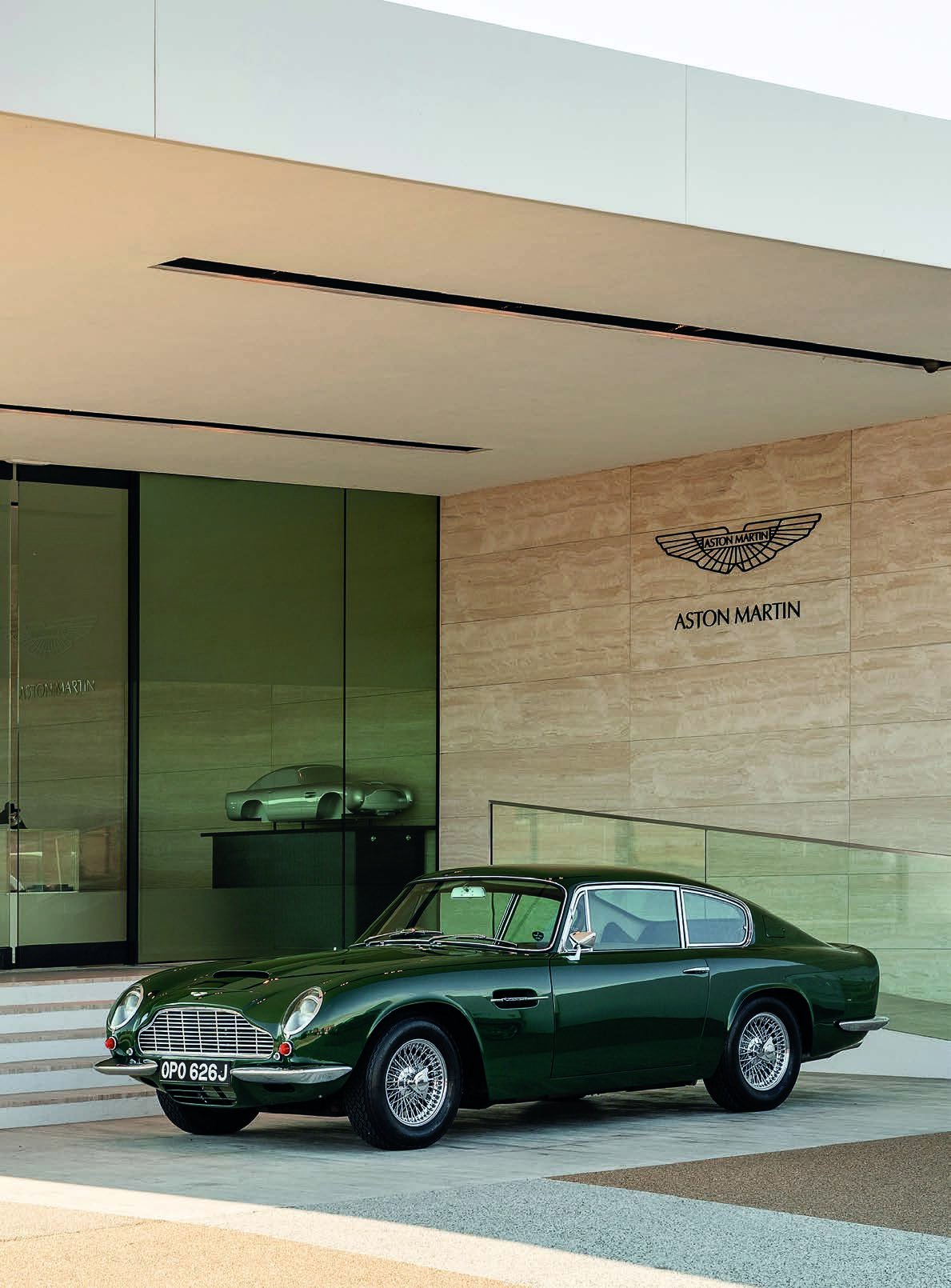
“Gather your tools men, we’re moving.” Perhaps this isn’t quite how Sir David Brown made the announcement but in 1955 Aston Martin moved from Feltham in West London to Newport Pagnell, a sleepy market town 50 miles north of London. This was before modern motorways so Aston Martin’s new home really was in the “back of beyond.”
Newport Pagnell is now the home of Aston Martin Works, the sales, service and restoration arm of the business and where the amazing Goldfinger DB5 Continuation cars are made. Why there? Sir David Brown bought Aston Martin in 1947. In 1955 he bought Tickford Coachworks based at Newport Pagnell and as they already built bodies for Aston Martin it was a logical move.
He had been a keen motorcycle racer in the 1920s and was reserve rider for the Douglas Racing Team at The Isle of Man TT. Unfortunately, once his father found out, he was forbidden to ride and sent to South Africa to learn more about the family business. When he bought Aston Martin his competitive streak was still burning brightly and, being a keen racer, he naturally thought he would drive one of the team cars at the 1950 Le Mans 24 Hours. This idea was stymied by the RAC Competitions department who thought he didn’t have enough experience to race at Le Mans, probably to the relief of the racing team manager, John Wyer.
“You have to be quite focused when racing what was then the world’s most expensive production car, I didn’t want to have to phone our CEO to tell him I’d stuffed the car!”
So, how did Paul become president?
“I was managing my own business, dealing with Aston Martins, then I joined a dealership. Aston Martin invited me to come here and set up the sales side. When the MD retired they kindly asked me to take over. In racing I had my own team in the ‘90s and competed in the British Touring Car Championship. In 2004 I was approached by a team to help them to the next level and we did Le Mans. I would have liked to have driven, but that wasn’t going to happen. I did drive again in GT4 racing and I also raced a DB4 GT Zagato Continuation down at Paul Ricard. You have to be quite focused when racing what was then the world’s most expensive production car, I didn’t want to have to phone our CEO to tell him I’d stuffed the car!” he says.
Paul is in good company because there is a common thread that runs through Aston Martin’s history of competition that goes from the boardroom to the workshop. Most of the greatest drivers from the 1950s drove for Aston Martin, and their team manager, John Wyer, went on to win with GT40s and Porsche 917s at Le Mans.
“How many restorations are you working on at the moment?” I ask.
“Six or seven. We do everything on site, paint, chassis and mechanicals. Most other manufacturers don’t have the same level of artisan skills in their restoration department. One of our trimmers is working on cars he built first time around! Our people are the key.”
Only 25 DB5 Goldfinger Continuations are being made, each one an exact replica of the Bond car, complete with bullet resistant screens and smoke ejectors. I’m not sure they have functioning ejector seats but imagine that those unhappy with their partner would like the option.
“We are not the James Bond Car Company but we are the James Bond car company. Initially, when the film company asked for a car, Aston Martin said no. They thought about it and decided they really needed an Aston Martin. We lent them a DB4 GT. After they had finished filming we repainted it red and sold it as a demonstrator. It’s disappeared, probably never to be seen again.”
No one could have imagined the tremendous success of the Bond films and the effect it would have on Aston Martin. Aston Martins have been used many times on screen. Peter Sellers used his own DB4 GT in Long Arm of the Law and Roger Moore, playing suave Lord Bret Sinclair, drove a DBS in The Persuaders (what else could a peer of the realm drive?), and of course James Bond has been driving an Aston Martin since 1963.
“If you read the build sheets from the 1950s it was very much like a who’s who of the aristocracy but, in the 1960s, you have The Beatles, Rolling Stones and Twiggy, all the iconic names had an Aston Martin” he adds.
As we walk and talk, two things become really apparent; the first is the level of cleanliness in all the workshops, the second is Paul’s fantastic rapport with his staff. We’re greeted with smiles as we enter the trim shop which Paul describes as an artisan’s heaven.
“Everything is done by hand. We’re particularly proud of our CAD design. If you are thinking of computer aided design then think again, in this case it means cardboard-aided design. All the interior panels and seats are cut from card templates. This is without doubt the most experienced trim shop you’ll find.”
I asked if the process could be accelerated? “No, you can’t speed it up without compromising quality, it’s an 18-month process, about 4,000 hours’ work, our clients understand that a car restored by The Works has a different price point.”
The quality of their work is exceptional and if you were lucky enough to own an Aston Martin what could be better than to have it restored by the same people who built it in the first place?
We move onto the body shop where the final Goldfinger car is being built complete with bullet resistant screen and revolving number plates. Paul shows me the new buck for the DB5 body where the Goldfinger cars are formed and explains how each piece of the wing is made then welded together. Unbelievably, you really can’t see the joins, it is sheer artistry in metal.
“We’ve invested massively and this enables us to make a much higher quality body part. Each DB5 front end takes 400 hours to make, it’s all done in the traditional way.”
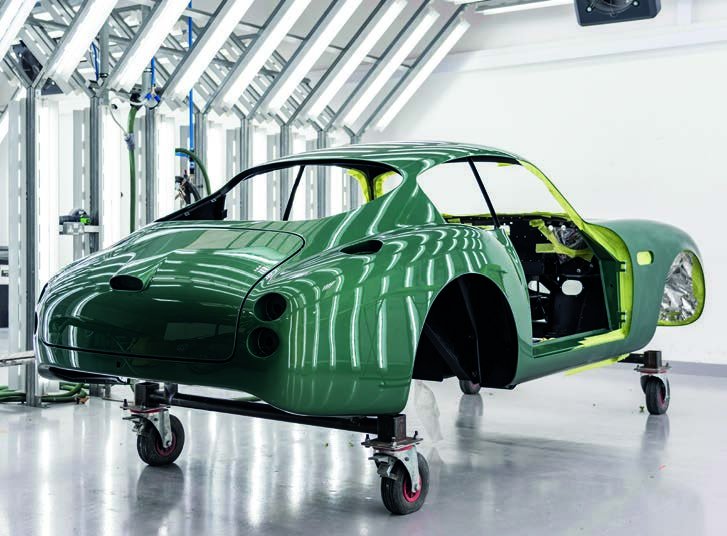
Our next stop is the paint shop. The first thing I see is a light booth that illuminates the car at three times natural daylight to show minute imperfections you wouldn’t normally see. Calling it a paint shop doesn’t do justice to the operation. Try to imagine a clinically clean, odourless brightly lit laboratory and you’ll get the idea. It’s like a high-tech Bond film set, hopefully next time I’ll get to see Q’s department as well.